what you have there is a coding sheet for a GP4. a stored program computer, with drum memory.
eventually, the company would call that a 'system design and mechanization report', which would document the math and equations needed to correctly simulate a small part of an aircraft.
note the marking "link division of general precision". the computer was made by General Precision, of which the Link aviation company was the biggest customer. i had always been told that Link purchased General Precision, but perhaps it was the other way around.
i worked in this industry for about 35 years. this stuff was ancient and forgotten about when I started.
I had no idea this closed and I've lived here for six years! I can't believe I didn't go visit.
Surely there is enough money in this city of Houston between airlines that operate here and the oil companies that they spend most of your ticket money on to keep this open?
It really was/is a gem of a museum, very fun to visit and quite approachable. We went a couple times, once when they had some fly-ins that made it extra special.
The rack in this image appears to house a Texas Instruments minicomputer of some model, not sure exactly which. 980 maybe? Might be fun to play with, but not for $20K.
At the minimum you’d need a telehandler or forklift capable of lifting 20,000 lbs (according to the listing) which is probably $1,500 for one day with delivery and pickup, a flatbed semi trailer to load it on, and labor to load it. If the equipment isn’t on skids you can lift with a forklift, then you need riggers and a crane truck. Either way sounds fairly expensive, and that’s without having a place to move it to.
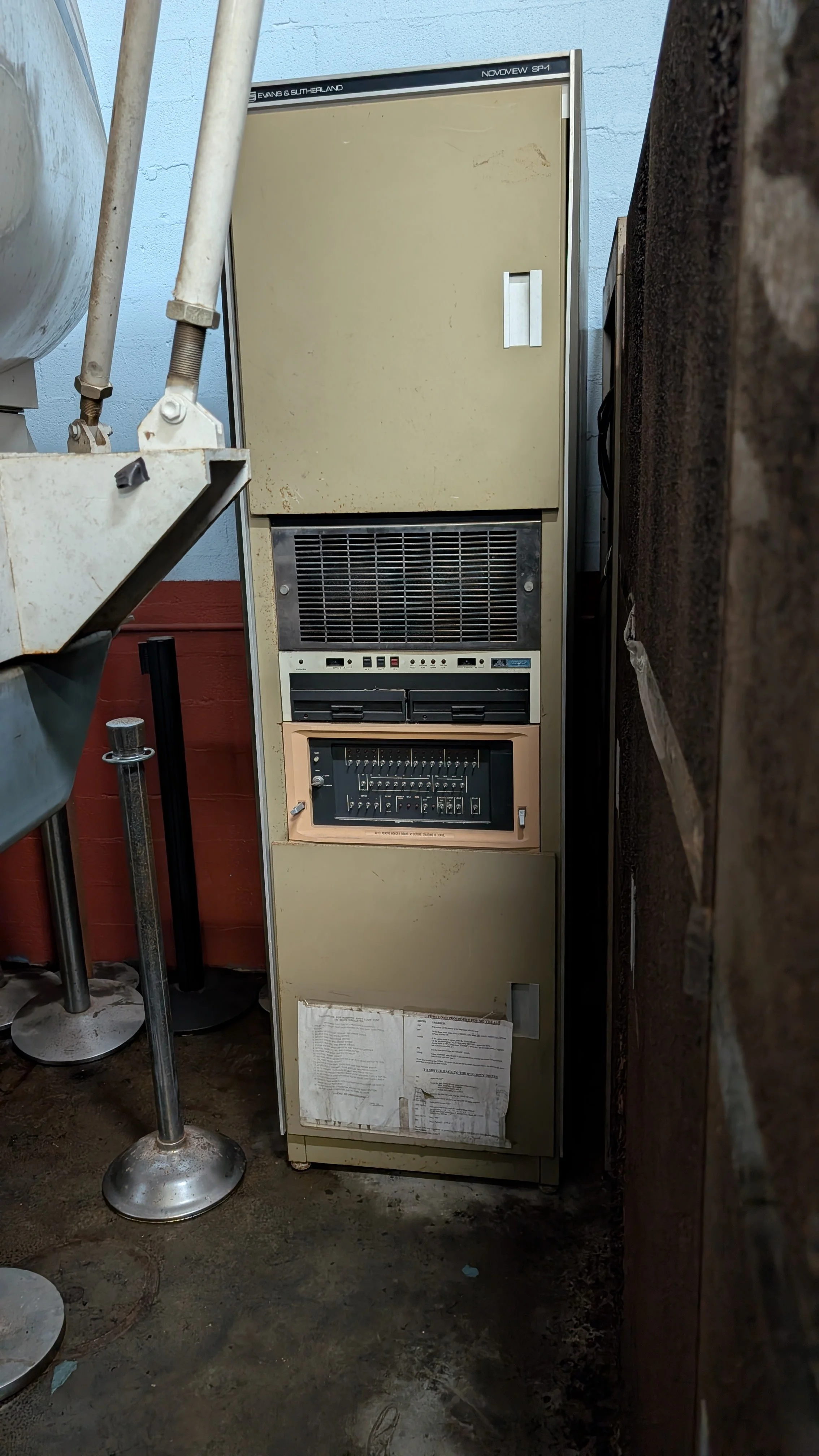
The E and S rack was an 'image generator'. That one was called an SP1. I fondly remember the SP3T as being the pinnacle of that series; the T meant "texture processing".
image a computer display made up of 1000 line segments. that is what you would get. it was possible to buy these with an output that was not raster, rather it drew on the CRT with vector segments. incredible light points to simulate night landings.
To anyone for whom Houston is a bit too far of a drive (plus the fact that the museum now seems closed), but Cincinnati is not: Union Terminal is another beautiful example of art deco.
Fellow Union Terminal aficionado here. Also highly recommend to any art deco architecture lovers.
Even if you're not into art deco architecture it's worth a visit. The Omnimax theatre is worth the trip alone, but the museums are great too.
@macintux - It's hard to get on the tour because they sell out, and they don't allow photography, but the high steel tour, which includes walking up to the top of the inside of the half dome, is great. There's some duplication with the behind the scenes tour but it's still worth it. It's probably second to the (now discontinued for liability reasons) Cincinnati subway tour in terms of seeing cool hidden stuff in the Cincinnati area.
that's seriously not the issue. if you look at the those pictures of the 737 frame - this is very large system which hasn't operated for many years and is largely just a pile of components at this point. it would probably be easier to rebuild the control system from scratch than try to bring it back to life. this would probably take a team of pretty serious people many years to get functional.
This is really sad. I was hopeful the Lone Star Flight Museum would take it over. I spent a few afternoons there with my then much smaller kids. It was a not overdone museum where you could explore around inside the vehicles like a Sikorsky S-34 and the not-working simulators.
I would love to see someone on CuriousMarc's, TubeTime's or Usagi's level of dedication get all that and rebuild/reconstruct it. Maybe if all the technology geeks of YouTube got together they could reconstruct one of those to a working level. The 737 one looks like it still has most of the components....



I don't think I've ever seen a manual that expected me to use DeMorgan's Theorem as part of a test procedure... :)
reply